Break your product before your customers do (HALT/HASS)
Factories love gentle testing. It keeps yields high, paperwork clean, and hides design flaws until your customers find them for you.
HALT and HASS are two of the most effective methods for finding what actually breaks and why.
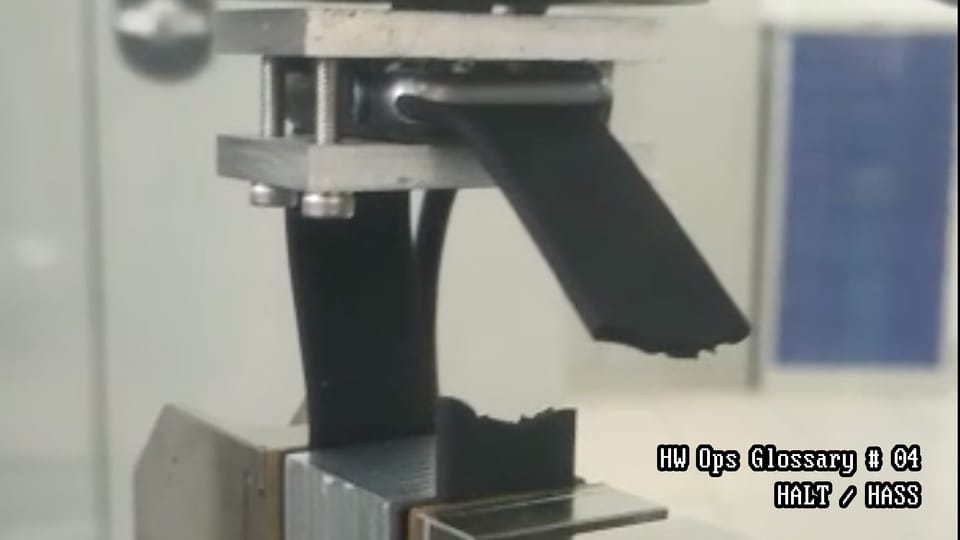
HALT (Highly Accelerated Life Testing) is a development tool. You push a small batch of units past their limits with extreme temperature cycling, vibration, and combined stresses until something fails. The goal is not pass/fail. The goal is to find the weakest link in your design and quantify your margins before production starts. HALT does not replace qualification testing. It informs it.
HASS (Highly Accelerated Stress Screening) is a production tool applied to 100% of units. You stress every unit to surface manufacturing defects before shipment: bad solder joints, loose connectors, marginal components. The stress is high enough to precipitate latent defects but calibrated below destruct limits so it does not consume product life.
The HASS profile is derived from HALT data. Without HALT, you are guessing at stress levels. Too low and defects escape. Too high and you damage good units or kill yield.
Testing that never breaks anything teaches you nothing.
The difference from standard reliability testing:
- Standard testing validates specs. HALT finds the specs you should have written.
- Standard testing uses comfortable margins. HALT uses margins that hurt.
- Standard testing tells you "pass." HALT tells you "this failed first, at this stress level, for this reason."
When to use each:
- HALT belongs in engineering, during development or after major design changes. Run it early when fixes are cheap.
- HASS belongs in production, especially for products where field failures are expensive or dangerous. Medical devices, industrial equipment, and automotive all fit this profile, but note that regulated industries require careful validation and change control before adding production screens.
The hard truth about implementation: HALT requires destroying units. Teams resist this because it feels wasteful. But the cost of finding a failure mode in HALT is a fraction of a field recall or warranty campaign.
HASS requires a capable factory. Not every CM has thermal chambers and vibration tables rated for accelerated screening. If your factory cannot run HASS, you are screening with hope.
Questions to ask your team and your factory:
- Have we run HALT on the current design? What failed first and at what margin?
- Is HASS in place for production? What is the screen profile and precipitation rate (screen fallout percentage)?
- What is the correlation between HASS escapes and field returns?
If nobody can answer, you are shipping products with unknown failure modes to customers who will discover them for you.
Reliability is not a checkbox. It is a discovery process.