Your lab has a memory leak (sample management)
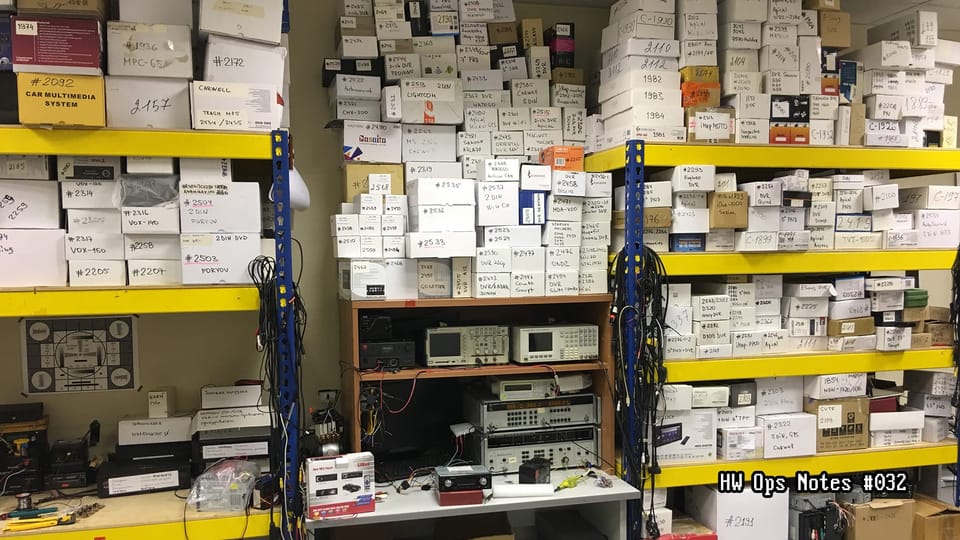
The most expensive thing in your lab is not the prototype. It is the unmarked bag of parts nobody remembers requesting.
That is a sample management problem. And if you do not solve it early, it compounds until someone re-tools a part because nobody can prove the first version passed inspection.
When I worked at the major audio brand, we processed thousands of samples over the years. Parts, sub-assemblies, competitor teardowns, golden units, pre-production builds. Every one went through the same system. We regularly pulled samples that arrived two or three years earlier and needed the full history.
A sample without an ID is not a sample. It is clutter.
We used S-1234 format. The "S-" prefix meant zero confusion with Jira tickets, part numbers, or chat tags. Anything starting with S- was instantly recognizable across emails, chats, and reports.
Here is what the system looked like:
- Every sample gets a unique S-ID and a row in the tracking spreadsheet (Google Sheets, nothing fancy). The row captures: supplier, part number/product id, sample description, revision, requester, purpose, date received, storage location, who checked it out, and linked ECO or build stage if applicable.
- Every sample gets physically labeled. Sticker on the part itself and on the box or bag it lives in. Unless the sticker interferes with the sample's purpose (cosmetic surface, sensor window, mating face), it goes on.
- Every sample gets inspected or tested based on why it was requested. The report links back to the S-ID in the tracker. Attachments live in a Drive folder named like this: "S-0237 ProDrive 5x9 midbass 2ohm 60W." One folder per sample, all photos and reports inside.
We always tightly controlled who checked out the sample. Without ownership control, a logged sample walks off a desk and the spreadsheet becomes fiction.
Revision matters as much as identity. "We tested it" means nothing if you cannot answer "which rev was that?" Tie every sample to its revision and ECO. That is what turns a parts drawer into evidence.
Why this matters more than founders expect:
- A quality issue surfaces six months later and you need the original test data for comparison
- A supplier disputes your rejection and you need the inspection photos from day one
- You are choosing between two versions and realize you already tested one 18 months ago
- A new engineer joins and needs full context without digging through old emails
The discipline is not in the tool. It is in the rule: if it arrived at your facility and relates to the product, it gets an S-ID. No exceptions. One skip and the system dies.