The line item that lies (but not on purpose)
This is the most durable decorative finish you can put on hardware. It is also the most expensive one to get wrong.
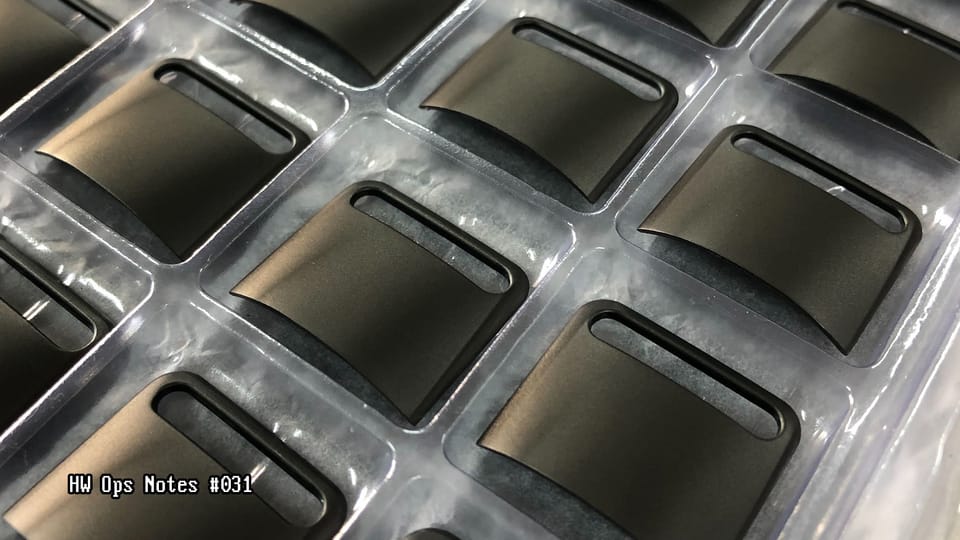
PVD (Physical Vapor Deposition) is the finish you see on premium hardware. Dark chrome on a watch case, anti-glare on surgical instruments, gold tone on consumer electronics. It is typically harder and more wear-resistant than electroplating, holds up better than decorative anodizing in most consumer applications, and when the process is dialed in, it lasts.
If you want a finish that looks premium and actually survives in the field, PVD is usually the right call.
But the economics will confuse you.
The process itself is not cheap. Vacuum chambers, target materials, cycle time, racking, masking, cleaning, inspection. All real line items. But none of them explain why the final batch invoice feels so much higher than the per-unit quote suggested.
The hidden multiplier is first-pass yield.
PVD replicates whatever is underneath it. Every dust particle, oil residue, micro-scratch, and handling mark becomes a visible defect after deposition. The coating does not level or hide the surface. It amplifies what is already there.
And most decorative PVD defects are not practically reworkable. Strip-and-recoat is technically possible, but on parts with tight color specs, recoating often shifts the finish just enough to fail inspection.
So the coating house asks to deliver more parts than needed. On complex decorative parts, first-pass yield can run 70-85%, depending on geometry, color, and how tight the acceptance spec is. Your numbers will vary, but the gap is always there.
You are not overpaying for the process. You are paying for the parts that did not survive it.
What drives yield down:
- Complex geometry with deep pockets, sharp inside corners, or thin walls
- Mirror finishes show every defect, matte finishes are more forgiving
- Tight color tolerances, especially on 3D surfaces where coating thickness uniformity is hard to control
- Poor handling or cleaning between your shop and the coating house
What to do before you commit to PVD as a finish for your product:
- Ask the coating house for first-pass yield data on similar parts and colors
- Build expected scrap into your cost model before you finalize unit pricing
- Simplify geometry where the finish spec allows it
- Define acceptance criteria with physical limit samples, not color codes on a PDF
- Track yield batch over batch and push for continuous improvement
Yield is not the only thing that makes PVD pricey. Chamber utilization, racking density, minimum lot charges, and color-change overhead all add up. But yield is what makes a beautiful finish so expensive.
What is the worst yield surprise you have run into on a coated or finished part?