When you see NRND, don't panic
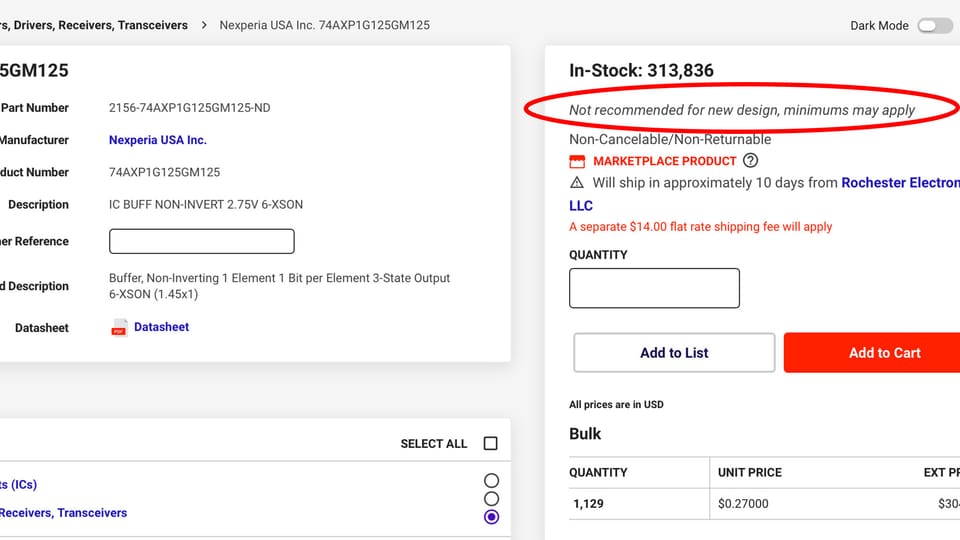
The IC you selected six months ago just showed an NRND flag. Your instinct is to panic and redesign. That instinct is probably wrong, and acting on it will cost you months.
The real problem is confusing three different signals:
- NRND means "don't start new designs with this part." You can often still buy it for years. But if you are mid-development, check the replacement path now.
- Allocation means supply is constrained. Lead times spike, distributors show limited stock, MOQs increase. Sometimes it resolves in weeks. Sometimes it lasts years or never fully recovers.
- EOL (end-of-life) means production will stop. The manufacturer issues a PDN (Product Discontinuance Notice) with a last-time-buy date and a last-ship date. Once the LTB window closes, that source is done.
NRND is "don't start." Allocation is "can't buy." EOL is "will stop."
Founders often see an NRND flag and react as if it were EOL. Or they ignore allocation warnings and get stuck when the part actually goes obsolete during ramp. Each situation requires a different response.
The real cost of an actual EOL is not the part swap. It is everything the swap triggers:
- Schematic changes (new pinout, new power rails, new passives)
- PCB respin (routing, layer stack, possibly form factor)
- Firmware updates (new drivers, new register maps, new timing)
- Full revalidation (thermal, EMC, reliability, safety)
- Re-test and re-file certifications you already completed
Each step takes weeks. Together they add months and significant cost to a program that was supposed to ship.
How to protect yourself before BOM freeze:
- Check lifecycle status directly with the manufacturer. TI, NXP, STMicro, ADI, and Microchip all publish this data. Distributor flags are helpful indicators, but the manufacturer lifecycle page is authoritative for status. PDN is authoritative for EOL.
- Subscribe to PCN and PDN notifications. PCNs cover changes like die shrinks or fab moves that can also force revalidation. PDNs cover discontinuance. This is the process fix that keeps you informed.
- Identify replacement paths for critical parts. For power ICs, analog, and discretes, pin-compatible alternatives often exist. For MCUs, SoCs, and RF modules, single-source risk is real and substitution is rarely simple. Know which parts have options.
- Plan an LTB strategy for anything critical and hard to replace. Monitor status and be ready to place a last-time-buy order the moment the notice drops.
Lifecycle management is not glamorous. But confusing NRND with EOL is one of the fastest ways to blow a schedule and redo work you already finished.
Know which signal you are looking at. Each one has a different clock.